Translate

Friday, 19 April 2013

The Tranquillity of Wuyuan


A local icon


Women washing by the river
If you like the tranquillity of country life, Wuyuan is the place you should go. There you will find country life at its best. Giant old trees, scattered traditional houses, live stocks,  rivers and farmlands all will make up a very beautiful landscape. As the place was pretty unknown to overseas travellers, we had to make special arrangement with travel agent for a tour to this remote part of China. Even when we reached there, the local tour guide was amazed that we knew this place and were to come up with the travel itinerary. The tour guide told us that usually Wuyuan was visited by local travellers, not many overseas visitors had heard of Wuyuan. That was a few years ago. Now most travel agents in Singapore will include Wuyuan in their advertising campaign. But for visitors who like busy city lives and plenty of shopping, probably they will skip this place. They do not realise how much they would miss. In this place you can really relax and immerse in the beauty of countryside life. You almost can feel that time really stands still and there is no need to worry about the uncertainty of tomorrow.
 
Wuyuan (婺源) is a county of Jiangxi province, People's Republic of China. It is under the jurisdiction of the prefecture-level city of Shangrao. Wuyuan, on the boundary of three provinces in Jiangxi's northeastern corner, has a landscape dotted with strange caves, deep secluded rocks and numerous historic sites. Wuyuan County is home to some of the best-preserved ancient architecture in China. Wuyuan's structures were built in 740 during the Tang Dynasty, its remoteness and inconvenient transportation protecting its villages from too many visitors.
 
River in Wuyuan

If you are an artist, you can put up your easel and start painting. Everywhere you will find beautiful landscapes for you to capture  on your canvas. Scenes like the bridges across the rivers, the villages, women washing by the side of river, the live stocks such as the ducklings and buffaloes and the padi fields and farmlands are interesting subjects for paintings. Occasionally you will bump into some friendly villagers who are keen to show you around the neighbourhood. Of course there are also villagers coming straight from their farmlands and trying to sell you some of their local produce to earn extra money. Do not worry, the price of such produce they are selling is generally very low.

Swimming ducklings

As we were wandering around in this vast country side, we came to a place where we saw a giant tree of more than one thousand years old standing in front of us. The tree was so huge that even 20 to 30 people could not embrace the tree trunk completely. This is the thing that most visitors would like to see, something special and unique that you won't be able to find in your own home town. We then gather together in front of the tree to take a group photo. After that some of us even tried to climb up the tree.
Tranquil country life

Waterway in village

Group photo in front of the giant tree

As Wuyuan is in Jiangxi, you will also get to visit the famous porcelain city of the world, Jingdezhen, and have a first hand knowledge of how porcelain ware are made, from the initial ware coming out of the potter's wheel to glazing and the final stage of firing (in electric furnace). When we arrived at the city, we were surprise to see that even the lamp posts were made of porcelain. These porcelain lamp posts line the streets in Jingdezhen as if giving us the unusual welcome to the city of porcelain.
Porcelain lamp post
Jingdezhen's porcelain is famous not only in China but in time it is known internationally for being "as thin as paper, as white as jade, as bright as a mirror, and as sound as a bell". A famous historian and well known scholar once wrote a poem that says (in translation): "China is well known in the world for its porcelain, and Jingdezhen is the most well-known centre, with the highest quality porcelain in China".
 
Most Jingdezhen porcelain is valued by collectors of antique porcelain throughout the world. According to media reports, a blue and white porcelain jar produced in Jingdezhen during the Yuan Dynasty was auctioned for the equivalent of RMB 230,000,000 yuan in London, UK on July 12, 2005. This was the highest price achieved by a piece of porcelain in the history of all porcelain auctions of the world. The reason for the high price is experts believe that the blue and white Yuan Dynasty porcelain has a dominant position in the history of Chinese ceramics. It represents the pinnacle of the development of Chinese blue and white porcelain.
Worker at Jingdezhen
A blue and white plate
Jingdezhen's natural resources include kaolin, coal, manganese, and lime, but it is the kaolin that has made the city famous in China and the world. For over a millennium, its unique kaolin has enabled Jingdezhen to make high-quality porcelain. Before we left Jingdezhen, we visited a few porcelain shops and purchased some good porcelain ware at very affordable price. There are also some high quality staff (such as porcelain paintings and crafts) produced by famous Jingdezhen artists, these were generally beyond the shoe string budgets of most travellers.

Painting on vase before firing

Thursday, 18 April 2013

The Paradise on Earth


Jiuzhaiguo
Is there a Paradise on earth? Yes, I believe there is.

Couple of years ago, we went to Jiuzhaiguo (九寨沟) and we found Paradise there. The scenery is so beautiful that we thought we were in Paradise, at least in my opinion, this place is extraordinary, not from this world. The landscapes, the waterfalls, the many lakes with clear and colourful water, water features and the surroundings, they look so different from all other places I have visited.  This place is unique and in a class of its own.No wonder the 6-star hotel there is also called Jiuzhai Paradise.
 
Jiuzhaigou iterally means "Valley of Nine Villages" is a nature reserve and national park located in northern Sichuan province of south western China. Jiuzhaigou is part of the Min Mountains on the edge of the Tibetan Plateau and stretches over 72,000 hectares (180,000 acres). It is known for its many multi-level waterfalls, colorful lakes, and snow-capped peaks. Its elevation ranges from 2,000 to 4,500 metres (6,600 to 14,800 ft). Jiuzhaigou Valley was inscribed by UNESCO as a World Heritage Site in 1992 and a World Biosphere Reserve in 1997.

 
Lake in blue hue
Jiuzhaigou can be difficult to access by land. The majority of tourists reach the valley by a 10-hour bus ride from Chengdu along the Minjiang River canyon, prone to occasional minor rockslides and in the rainy season, mudslides that can add several hours to the trip. For our trip to Jiuzhaiguo, we flew to Chengdu, then we took a local flight directly to Jiuzhai Huanglong Airport on a 11,311 ft (3,448 m) high mountain side near Songpan County, and then a 90-minute bus ride to Jiuzhaigou. This was before the May-2008 earthquake that rocked the region. The highway that had been  badly damaged during earthquake has now been repaired. Further repairs from Mao Xian to Chuan Zhu Si are still ongoing but the road is open to public buses and private vehicles. Due to the large number of tourists that come to this place, more flights have been added daily from Chengdu, Chongqing, Xi'an, Beijing, Shanghai and Hangzhou. Since opening, tourist activity has increased every year: from 5,000 in 1984 to 170,000 in 1991, 160,000 in 1995, to 200,000 in 1997, including about 3,000 foreigners. Visitors numbered 1,190,000 in 2002. As of 2004, the site receives an average of 7,000 visitors per day, with a quota of 12,000 being reportedly enforced during high season to ensure minimum damage to the environment of the region.       
 
Jiuzhaigou's landscape is made up of high-altitude karsts (landscapes formed from the dissolution of soluble rocks including limestone, dolomite and gypsum) shaped by glacial, hydrological and tectonic activity. It lies on major fault lines on the diverging belt between the Qinghai-Tibet Plate and the Yangtze Plate, and earthquakes have also shaped the landscape. The rock strata is mostly made up of carbonate rocks such dolomite as well as some sandstone. The valley includes the catchment area of three gullies (which due to their large size are often called valleys themselves), and is one of the sources of the Jialing River, part of the Yangtze River system.
 
Jiuzhaigou's best-known feature is its dozens of blue, green and turquoise-coloured lakes. The local Tibetan people call them "Haizi" in Chinese, meaning "son of the sea". Originating in glacial activity, they were dammed by rockfalls and other natural phenomena, then solidified by processes of carbonate deposition. Some lakes have a high concentration of calcium carbonate, and their water is very clear so that the bottom is often visible even at high depths. The lakes vary in colour and aspect according to their depths, residues, and surroundings. Some of the less stable dams and formations have been artificially reinforced, and direct contact with the lakes or other features is forbidden to tourists. Some tourists come to this place during the four seasons of the year to enjoy the views of different seasons. Generally, the best time to come to Jiuzhaiguo is during late October period where the plants and flowers blossom and the whole region becomes very colourful. In winter, everywhere is covered with snow, again if you don't mind the cold. The view can be spectacular.
Scenic view of Jiuzhaiguo
Jiuzhaiguo
File:1 jiuzhaigou valley shuzheng village panorama 2011.jpg
Shuzheng Village, the busiest Tibetan village in the valley
Scenic view of waterfall
There is this little Huanglong  黄龙 in Jiuzhaiguo that closely resembles the true Huanglong, a scenic and historic interest area in the northwest part of Sichuan, China which is located in the southern part of the Minshan mountain range, 150 kilometres (93 mi) north-northwest of the capital Chengdu. This area is known for its colourful pools formed by calcite deposits, especially in Huanglonggou (Yellow Dragon Gully), as well as diverse forest ecosystems, snow-capped peaks, waterfalls and hot springs.

Calcite ponds


Plenty of water in this region

The ponds in little Huanglong with its distinctive brownish colour of calcite deposits.
The water in the lake in Jiuzhaiguo is so clear that you can see the things that are submerged underneath the water.

Clear water in Lake

Black panda
One icon tourists won't miss when they are in Sichuan is the giant panda. This lovely animal, an endangered speci-es, is easily recognised by the large, distinctive black patches around its eyes, over the ears, and across its round body. black panda.

The black panda
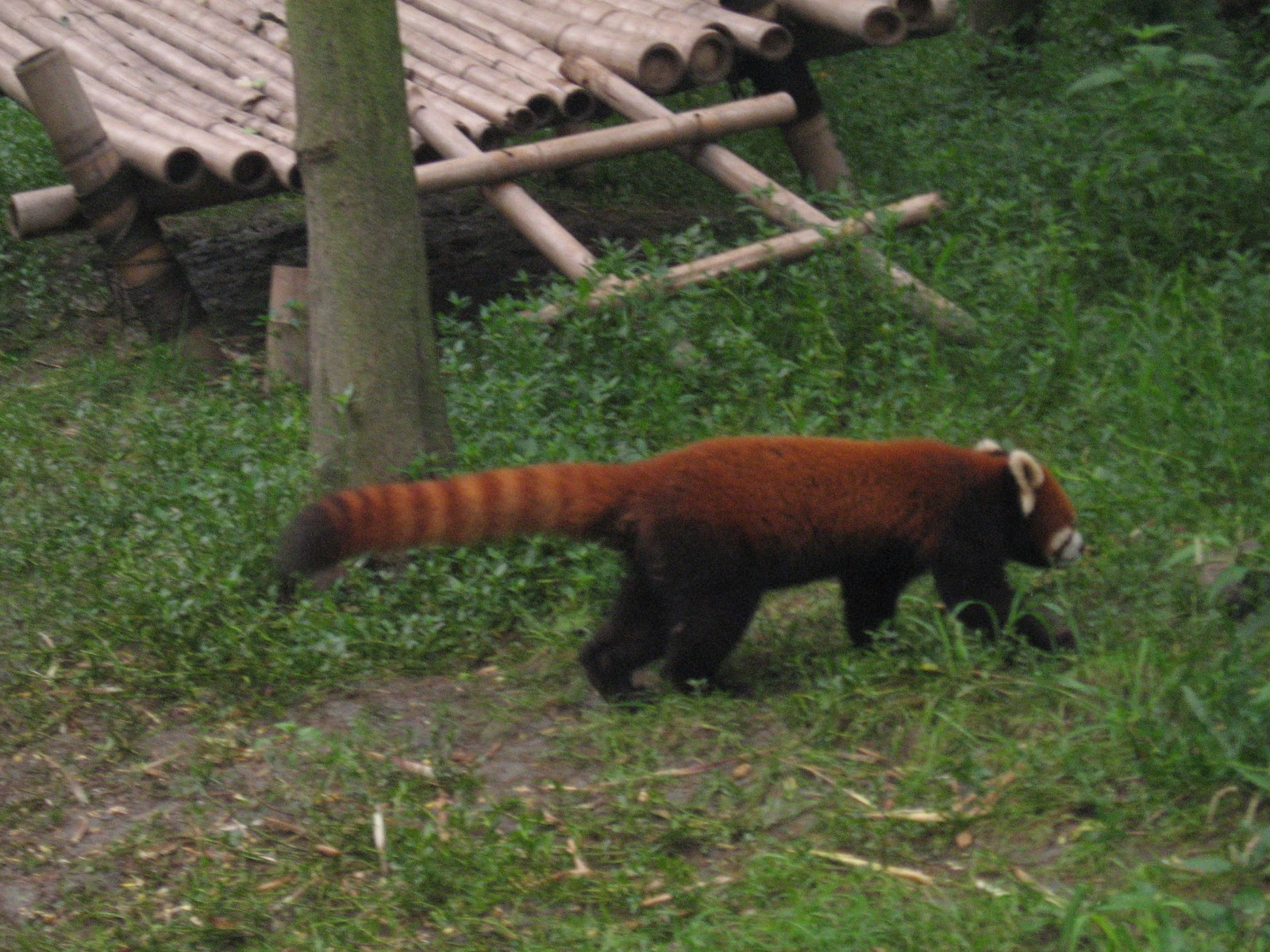
The red panda
The other species is the red panda which is slightly larger than a domestic cat; it has reddish-brown fur, a long, shaggy tail, and a waddling gait due to its shorter front legs. We were able to see these two different types of panda when we visited the local zoo which is actively involved in the breeding of the endangered species, the black panda.

Wednesday, 17 April 2013

Beautiful Dongbei

Northeast China, historically known as Manchuria, consists of the three provinces of Liaoning, Jilin and Heilongjiang. The region is sometimes called the Three Provinces of Dongbei (东北三省).
This region was one of the earlier regions to industrialise in China. It is, on the whole, more heavily urbanised than most parts of China, largely because it was the first part of the country to develop heavy industry owing to its abundant coal reserves. Major cities include Shenyang, Dalian, Harbin, Changchun and Anshan, all with several million inhabitants. Harbin, more than any other city in China, possesses significant Russian influences: there are many Orthodox churches that have fallen out of use since the Cultural Revolution. Shenyang and Dalian, meanwhile, have sizable populations of Japanese and Koreans due to their traditional linkages.

Recently my wife and I went on a 8-day tour to Dongbei and visited cities like Shenyang, Dalian, Changchun and Harbin. There are many tourist attractions in this north eastern region of China. For instance, there is the Red Beach in Panjin, not far from the city of Dalian; Imperial Palace of the Manchurian dynasty in Shenyang; Changbaishan and Tianchi in Jilin. We even had a glimpse of China's first aircraft carrier docking in a shipyard in Dalian under refurbishing work.
 
When we were at Harbin, we went to the central street and Gougell Street, the most prosperous street in Harbin. It is also an architecture art gallery, with the most influential architecture schools in western-style architectural history, such as Baroque, Eclecticism and so on. Everywhere, we noticed the strong influence of Russian culture in buildings and parks. It is amazing to find a large church in the city which was built based on Russian style architecture. This is the St Sophia Orthodox Church which is the most impressive and attractive structure of orthodox churches and Russian style facades in Harbin. .

St Sophia Church
Russian church
 The large dome of the church building has a distinctive bluish hue. The church looks grand and magnificent from far. There are also quite a number of similar buildings around when we arrived at Volga Manor where we stayed one night and watched a Russian style show, performers were all Russians.  Every building in this manor is authentic Russian style and all the construction materials were imported from Russia.


The Changbaishan region is the most interesting part of the tour. Changbaishan was still covered with patches of snow even during the period of late March when we were there. However, the best part of Changbaishan is undoubtedly Tian Chi or Heavenly Lake. The lake was formed in the crater of Changbaishan, which is the source of  the Songhua, Tumen and Yalu Rivers. Changbaishan is also the cradle of Manchu, Korean and Han people.

The orthodox church
Tian Chi 天池 , the Heavenly Lake, is often covered with clouds. It looks just very mysterious, as the clouds obstruct the full view of the Lake for those anxious visitors from afar. The tour guide told us that 7 out of 10 times, the place is covered with dense clouds and the Lake is almost invisible to the eyes. So tourists only have 30% chance of viewing the magnificent view of the lake. We were also the unlucky ones (70% of the tourists) as the weather of that day was so bad that we could not even see our own fingers, let alone the majestic view of the heavenly lake, it was just disappointing.

.
Russian architecture
Changbaishan - famous for Ginseng
Red Beach of Panjin
Manchurian Palace
 
Heavenly Lake 天池 on a clear day
File:Panorama Himmelssee 3800px.jpg
Panaromic view of Tian Chi

The Red Beach scenic area of Panjin is a place worth visiting. From afar, visitors can see an endless stretch of reed marshes with a unique red hue. The place is like having a big red carpet spreading across the plain, hence the name Red Beach. The view is spectacular.
The Moonbay Wetland
A direct contrast to this red vision of the Red Beach is the Moonbay Wetland which is a huge field of reeds with the distinctive greenish appearance (green vision). It was relaxing to walk on raised platform and watch the reeds blowing in the wind. This stretch of vast green is indeed very soothing to the eyes.
The Red Beach

Tuesday, 16 April 2013

Fujian Tulou

If you plan to go to Fujian, a province of China, there are a few interesting places to visit. One of them is the Fujian Tulou, 福建土楼; a type of Chinese rural dwellings of the Hakka (a dialect speaking group) in the mountainous areas of China. They were mostly built between the 12th and the 20th centuries. 

Based on the literal meaning of the Chinese words tu (土; "earth") and lou (樓; "building"), one may think of the term "tulou" as a building made of earth. As the name suggest, a tulou is usually a large, enclosed and fortified earth building, most commonly rectangular or circular in shape, with very thick and strong earth walls between three and five stories high. These Tulous can and house up to 80 families. Within these huge peripheral walls (well reinforced with earth mixed with stones) are halls, storehouses and living areas, the whole earthen building looks like a small fortified city which is well-lit, well-ventilated, windproof and earthquake-proof.The building is warm in winter and cool in summer. Tulous usually have only one main gate, guarded by thick wooden doors reinforced with an outer shell of iron plate. The top level of these earth buildings has gun holes for defence purposes. From the 12th century to 19th century, armed bandits plagued southern China. The people of southern Fujian first built strongholds on top of mountains as a defence. These early strongholds later evolved into Fujian Tulou.

A total of 46 Fujian Tulou sites, including Chuxi tulou cluster, Tianluokeng tulou cluster, Hekeng tulou cluster, Gaobei tulou cluster, Dadi tulou cluster, Hongkeng tulou cluster, Yangxian lou, Huiyuan lou, Zhengfu lou and Hegui lou, have been inscribed in 2008 by UNESCO as World Heritage Site, as "exceptional examples of a building tradition and function exemplifying a particular type of communal living and defensive organization [in a] harmonious relationship with their environment".

A Tulou Cluster
A Tulou Cluster
The layout of Fujian tulou followed the Chinese dwelling tradition of "closed outside, open inside" concept: an enclosure wall with living quarters around the peripheral and a common courtyard at the centre. A small building at the centre with open front served as an ancestral hall for ancestry worshipping, festivals, meetings, weddings, funerals and other ceremonial functions. Ground floor plan includes circle, semicircle, oval, square, rectangle, and irregular pentagon.
Tulous were usually occupied by one large family clan of several generations; some larger tulou had more than one family clan. The residents share many facilities such as water wells, ceremonial hall, bathrooms, wash rooms, and weaponry. They even the surrounding land and farmland, fruit trees, etc.   Nowadays newer houses with modern facilities are popping up in rural China. Many residents have bought these modern houses and moved out, or live in a larger town or city for better jobs. However they keep their ancestral tulou apartment homes under padlock, only returning home during festival for family reunion.
Livestock
Buildings in neighbourhood
The thick outer walls of tulous were immune to arrows and gunfire. The lower one- to two-metre section of the outer wall was sometimes built with granite blocks or large river cobbles. This granite or cobble section was immune to digging, since the outer layer of cobbles was purposely laid with the smaller ends pointing outwards—it would be futile for bandits to dig out such cobbles. Digging a tunnel under the wall was not possible either, because the cobble section wall was extended deep down more than one metre. In this way, the Tulou is well fortified against attacks from any enemies.
The interior of Tulou
In front of a Tulou
We visited one such Tulou when we were in Fujian sometime ago. The building is still very sound after so many years even tough it is not made of concrete, amazing isn't it.

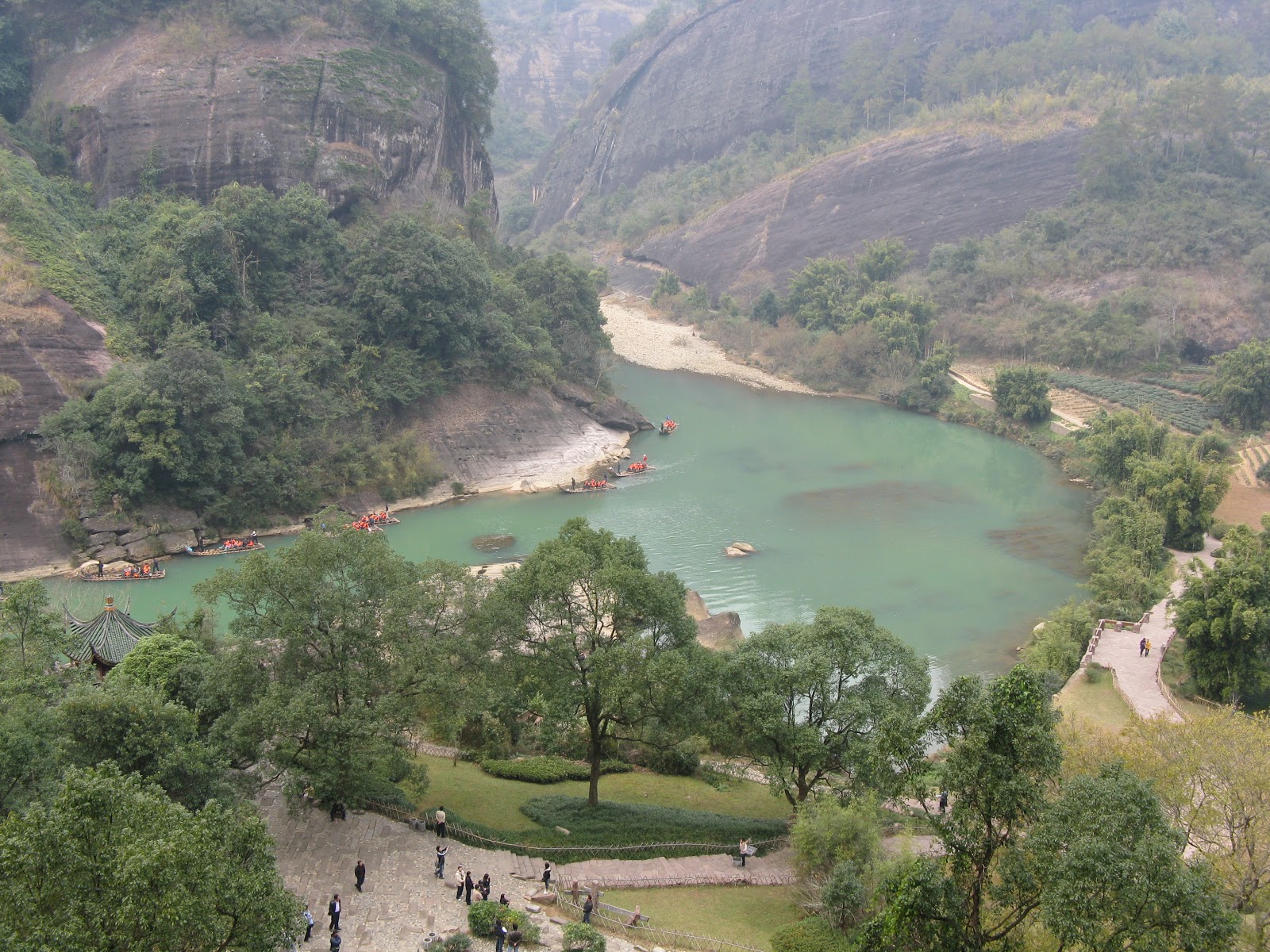
Another scenic attraction we visited in Fujian is the Wuyishan. The landscape of Wuyishan is characterised by winding river valleys flanked by columnar or dome-shaped cliffs as well as cave systems. Peaks in the western portion of the Wuyi Mountains typically consist of volcanic rocks, whereas peaks and hills in the eastern area are made up of red sandstone with very steep slopes but flat tops. The Nine-bend River (Jiuqu Xi), about 60 kilometres in length, meanders in a deep gorge among these hills. The highest peak in the area is Mount Huanggang at 2,158 metres (7,080 ft) on the border of Fujian and Jiangxi, making it the highest point of both provinces; the lowest altitudes are around 200 metres (660 ft).  The mountains of Wuyishan have been listed as a UNESCO World Heritage Site, for its cultural, scenic, and biodiversity values since 1999.

Sceniv view of Wuyishan
This region is also famous for a special tea called the Dà Hóng Páo ( 大红袍 literally means "Big Red Robe"), a prestigious Wuyi oolong tea. According to legend, the princess of a Ming emperor was cured of an illness by this tea, and that emperor sent great red robes to clothe the four bushes from which this tea originated. Three of these original bushes, growing on a rock on Mount Wuyi and reportedly dates back to the Song Dynasty, still survive today and are highly valued. Known for its highly expensive value and quality, Da Hong Pao tea is usually reserved for honoured guests in China.
Enjoying Wuyi tea in a local teashop

Monday, 15 April 2013

The Beauty of Zhangjiajie

More than 30 years ago, a renowned Chinese artist Wu Guanchong was once looking for inspirations for his art works and he discovered Zhangjiajie (張家界). As he was an artist by training, he straight away noticed that the mountains in Zhangjiajie were very unusual. The most notable geographic features of the park are the pillar-like formations that are seen throughout the park. They are the result of many years of erosion. The weather is moist year round, and as a result, the foliage is very dense. Much of the erosion which forms these pillars are the result of expanding ice in the winter and the plants which grow on them. These formations are a distinct hallmark of Chinese landscape, and can be found in many ancient Chinese paintings. As an artist himself, these scenes (landscape) were far too familiar to him. He was so amazed and marvelled at the finding of this beautiful scenic attractions in China that prompted him to write an article in the press. In his article, he borrowed a phrase in the song/poem 長 恨 歌 (The Song of Everlasting Regret by Bai Juyi in the year 806 to describe the love story between Yang Guifei and the Tang emperor which read like this 養在深閨人未識) to describe the beauty of Zhangjiajie. This phrase 養在深閨人未識 means a beautiful lady kept inside her bedroom and nobody has noticed her. What he actually meant was that the beauty of Zhangjiajie is well hidden and awaiting discovery.

A pillar like mountain
A lake by the mountains

After his article was published, it created a stir in the the tourism circle and people began to flop to Zhanjiajie to see this heavenly place themselves. Over night, Zhangjiajie became a famous icon, well know and a darling destination for the tourism industry. The government began to pour in money to develop this region into a sought-after tourist attraction. There was even a joint venture between Chinese and German firms to build an elevator on the side of one of the mountains. The Bailong Elevator (百龙电梯) (literally Hundred Dragons Elevator) is a glass elevator built onto the side of a huge cliff  that is 1,070 feet (330 m) high. The time we visited Zhangjiajie, the elevator was in operation. We were able to take the elevator directly up to the top of the mountain and at the same time, enjoy the scenic view of the surroundings through the glass panels of the elevator. The experience was terrific as the elevator is claimed to be the highest and heaviest outdoor elevator in the world.    

Just like Chinese painting
Zhangjiajie ( 张家界) is a prefecture-level city in the northwestern part of Hunan province in China. It comprises the district of Yongding (永定) and counties of Cili (慈利) and Sangzhi (桑植). Within it is located Wulingyuan Scenic Area which was designated a UNESCO World Heritage Site in 1992 as well as an AAAAA scenic area by the China National Tourism Administration. The three-character name (张家界) can be interpreted as follows: "Zhang" (张) is a common surname in China; "jia" (家) can be translated as "family"; and "jie" (界) can be translated as "homeland", giving the completed translation of "Zhang family homeland." The official version of its name is linked to a Han general, Zhang Liang, who resettled in the area after a suspicious Liu Bang, the Han emperor, started to persecute his staff and generals who had contributed to his success of establishing the Han Dynasty. It was so named to signify that the Zhang family had set up home there.


Bailong Elevator
The city itself was previously known as Dayong (大庸), Zhangjiajie City was adopted in 1994, after the National Forest Park in the Wulingyuan Scenic Area (武陵源) in order to give it more prominence and after this site had been designated a UNESCO World Heritage Site in 1992. Tourists who like to visit the national park can fly directly to an airport recently built in the city.

Tienmen Mountain

Glass panel walkway
Another attraction not to miss in the region is the Tianmen Mountain National Park with a noticeable big hole in the mountain. In the past, there was an international event organised for many small planes to fly through this narrow passage through the mountain. Recently glass panel type of walkway was erected round some mountains so tourists can be closer to the surroundings, but not for the weak heart. It must be certainly both challenging and fascinating to walk on such a walkway. You have to be there to admire the wonders of nature, the heritage of the world.
Planes flying through the opening in the mountain

Sunday, 14 April 2013

Fortified Towers - Dialous

Our visit to Kaiping of Guangdong two years ago brought us to see a different type of buildings called Diolous or fortified towers. Lou in mandarin has the meaning of tower, Diolous are also common in other counties such as Enping, Taishan ans Xinhui. The early laboureres to North Ameriac, Australia and South East Asia wer mainly from these four counties of Guangdong.

The first towers were built during the early Qing Dynasty, reaching a peak in the 1920s and 1930s, when there were more than three thousand of these structures. Today, approximately 1,833 diaolous remain standing in Kaiping, and approximately 500 in Taishan. Although the diaolous served mainly as protection against attacks by bandits, a few of them also served as living quarters. Kaiping has traditionally been a region of major emigration abroad, and a melting pot of ideas and trends brought back by overseas Chinese. As a result, many diaolous incorporate architectural features from China and from the West.

In 2007, UNESCO named the Kaiping Diaolous and Villages (开平碉楼与村落) in China as a World Heritage Site. These Diolous displayed a complex and flamboyant fusion of Chinese and Western structural and decorative forms. They reflect the significant role of émigré Kaiping people in the development of several countries in South Asia, Australasia, and North America, during the late 19th and early 20th centuries, and the close links between overseas Kaiping and their ancestral homes. The property inscribed here consists of four groups of Diaolou, totalling some 1,800 tower houses in their village settings.
Entrance to Li Garden


Statue of Owner, Li Garden


Another corner at Li Garden


Furnishings inside Li Garden
View of Dialou

Garden inside Li Garden


Some of the more prominent Diolous are Ruishi Diolou, the Majianglong Diolou, Li Garden, Fangshi Denglou, Bianchouzhu Lou and the Tianlu Lou. Ruishi Diaolou, located behind Jinjiangli Village, Xianggang Township. Constructed in 1921, it has nine floors and is the highest diaolou at Kaiping. It features a Byzantine style roof and a Roman dome. The Majianglong diaolou cluster spread across the villages of Nan'an Li, Hedong Li, Qinglin Li, Longjiang Li and Yong'an Li. Li Garden, in Beiyi Xiang, was constructed in 1936 by Mr. Xie Weili, a Chinese emigrant to the United States. Fangshi Denglou - Built in 1920 after contributions from villagers, this Denglou is five stories high. It is referred to as the "Light Tower" because it had an enormous searchlight with a brightness much like that of the beam of a lighthouse. Bianchouzhu Lou (The Leaning Tower), located in Nanxing Village was constructed in 1903. It has seven floors and overlooks a pond. Tianlu Lou (Tower of Heavenly Success), located in Yong'an li, was built in 1922 and is seven storeys tall plus a roof top floor.

The Dialou we visited was the Li Garden which has big garden inside with man-made lake and mountains. I took a picture of the bronze statue of the owner in front of the Dialou. The furnishings inside the Dialou was a  mixture of modern and traditional style, with a lot of old Chinese wood furniture. This was typical of a combination in architectural features of the east and west. There was even one western style toilet cistern which remained in good conditions, probably not being used before. The Dialou was built with massive concrete walls to fend of attacks from bandits which were active during that periods. Another reason for such heavy fortification was to protect the buildings from natural disasters such as floods and typhoons, which were also common those days. The compound inside the Li garden was so big that visitors can easily lose sense of direction inside. Nowadays, the villagers have left the Dialous and seek better and more modern houses that the government provides. Many of the Dialous are no longer occupied and some less prominent towers do not even have care takers to carry out essential maintenance work.

A bronze statue inside Li Garden