Translate

Saturday, 13 April 2013

Silk Road by Train

Come join me to explore Silk Road by train, not on a camel's back. I am serious. In early days, the only mode of transport on Silk Road was by camels, the animals that would survive the harsh conditions across miles and miles of deserts and wastelands. Now we have the luxury and comfort to travel on an express train, no doubt it might not be as comfortable as buses, but certainly it is better than on the back of a camel. Anyway, it didn't come cheap as we charted the whole train for our very own use, just to take us (no other passengers) across the deserts, on the Silk Road Trail.

The Silk Road or Silk Route is a term referring to a historical network of interlinking trade routes across the Afro-Eurasian landmass that connected East, South, and Western Asia with the Mediterranean and European world, as well as parts of North and East Africa. Extending 4,000 miles (6,500 km), the Silk Road gets its name from the lucrative Chinese silk trade along it, which began during the Han Dynasty (206 BC – 220 AD). The central Asian sections of the trade routes were expanded around 114 BC by the Han dynasty, largely through the missions and explorations of Zhang Qian (an envoy who explored the North during the Han Dynasty), but earlier trade routes across the continents already existed.

Our portion of the silk Road is only limited to the northern China portion between Xi'an and Urumnqi in Xinjiang. Last year we joined a tour organised by a travel agent here who deals mainly on Silk Road by Train (other tours may use buses to cover the whole journey). The advantage of train is that at night, while the tourists are sleeping (the noise from the rattling train is a constant nuisance), the train can continue its journey. In this way we saved valuable travelling time and the Silk Road tour can be covered in just over 7 days compared to 14 days or more by bus. Bus driver had to sleep at night, so the tourists bundled into hotel every night.

We began out tour by first flying to Xi'an, taking a local flight to Urumqi, then boarding an express train and travelling eastward back to Xi'an. When we were at Urumqi, we visited Ghost City where gust of wind and sand produced howling scream of ghost. A famous tourist attraction is the Kanas Lake with breathtaking scenery, the sky and the lake almost share the same hue. It was beautiful. We also visited places like the Tuwa village, Flaming Mountain, the Grapes valley and Karez well in Turban. We were welcome by the chief of a local tribe at Turban to taste the grapes at his residence. As usual, he would then do his part (sales promotion for extra income) to promote the different types of raisins produced by the local farmers.
Kanas Lake
A whole roasted lamb


From Turban, we then arrived at Liuyuan train station. The place was filthy (rubbish thrown everywhere) with local people sleeping on the streets, pavements and even at the centre of roads. Beside them, heaps and heaps of rubbish with flies on the garbage. I supposed nobody care about cleanliness and health issues. Everybody is just passing by, ready to go to their next destination. Yes, and they were all waiting for their trains to take them out of here. As we were VIP (if you were visitors, you enjoy different status), we were able to bypass a lot of local people and went inside the station directly. Once inside, we waited for the train to arrive. We boarded the Express train to continue the next part of the journey on train. We all checked in our little twin sharing cabin, this would be our home for the next 4 days of our tour. One problem tough, there was no bath room/toilet in our little cabin, so the 10 of us would have to share a common bath room/toilet at the end of the coach. We needed to create a  roster so that every one can take turn to have shower. A piece of paper was placed in front of the bath room and we started to book our slot to take bath. Each was only allowed to at most 15 minutes to finish the bath. I remembered the first night on the train, by the time the last person had taken his shower, it was almost midnight. After we had settled down it was dinner time. As there were other passengers on this charted train, we had to have dinner in two batches. Dinner was served on a two separate coaches called the Restaurant Coach. There was also a bar serving wine and alcohol to guests. After dinner and having taken the shower, we went back to the cabin to rest. As it was dark, there was nothing to see and we went to bed early. I can tell you it was almost impossible to sleep due to the rattling noise from the train and the tight "bed" (actually our seat by day). By the time we opened our eyes, we could see beautiful sun rise from the windows of the train. Then again, we began to do the usual morning task like changing clothes, brushing teeth, going to toilet, etc.
Liuyuan Train Station
Having dinner onboard the train


Our little cabin, not as cosy as a hotel room tough
One of the highlights of this tour was a visit to the Mogao Grottoes (also known as Dunhuang Caves) in Dunhuang. This is a UNESCO World Heritage site since 1987. It also has the reputation of caves of the thousand Buddhas, from a system of 492 temples. The caves contain some of the finest examples of Buddhist arts spanning a period of 1000 years. The Mogao Caves are the best known of the Chinese Buddhist grottoes and, along with Longmen Grottoes and Yungang Grottoes, are one of the three most famous ancient sculptural sites of China. We were amazed at these sculptural works, all crafted following the pattern of the caves, some even extending to the roof, some site contains so much Buddha statues that it was impossible to count their number. The tour guide told us that quite a good portion of these statues were stolen in early days by foreign visitors who were shocked at the beauty and magnificent works of Buddhist art. Most of these Buddha statues ended up in museums all over the world. The destruction caused to the ancient treasures was beyond description.

Mingsha Hill
Mogao Grottoes


A visit to the Mingsha Hill, a place full of sand and sand hills, just like the desert,  was also unforgettable. We had to loan from vendors a pair of cloth shoes (looked just like socks) to cover our footwear as we wondered into the wilderness of the land of sand. This was to prevent sand from getting into our shoes. Tourists can choose to ride camels or sit on camel carts to tour the desert. I missed the chance for a camel ride but later made it up in Jiayuguan where I mounted on a camel for photo shooting purpose. The experience was plain awkward, I really pity the travellers of those good old days, they had to endure the discomfort (not to mention the smell coming from the animal) on the back of a camel for miles and miles of journey across the deserts. When eating is concerned, one thing worth mentioning in Xinjiang is the roasted lamb. It is very tasty and the texture is equally good. It can come in the form of one whole roasted lamb or more commonly in pieces of lamb on sticks. They are equally good to eat although your cholesterol level may rise, but who cares, anyway.

Riding a camel, but not in Mingsha Hill
We also visited Jiayuguan or the "First and Greatest Pass under Heaven" and viewed Mt Qilian from far. Other places of interest included the Great Wall City Museum and the Xuanbi Greatwall. Fianally we boarded the train and headed for Lanzhou, the last leg of the tour. At Lanzhou, we visited the waterwheel Garden, the White Pagoda Hill and the Mother River Statue. After Lanzhou, the train would go on to Xi'an, the last stop of the tour. As we had been to Xi'an on another occasion, we did not join the group. So we said bye bye to the rest and flew home from Xi'an.

Xuanbi Greatwall

Outside the train with a staff


Farewell party at Lanzhou
Beautiful sun rise


Friday, 12 April 2013

The Three Gorges

Two years ago, my wife and I embarked on a 8-day Yangtze River Chongqing Tour in China. The first part of the tour was at Chongqing where we spent three days visiting waterfalls, Mountains and cultural sites. On the 4th day, we reached Yichang where we boarded a cruise ship to begin our cruise ride along the Yangtze River and the Three Gorges  三峡  and all the way upstream along the river to the port in Chongqing. We spent one more day in Chongqing visiting museums, sight seeing and shopping and before we boarded a plane and flew back to Singapore.

The highlight of the tour was a 4-day cruise ride along the Yangtze River on a five stars luxury cruise ship called the Century Diamond. The ship has 6 decks and is equipped with a passenger lift. We had a room on the 5th floor fully furnished with amenities, just like a hotel room. The ship is also equipped with a big dance and entertainment floor, restaurants, fitness room and other facilities. There are deck chairs and a lot of open space on the upper most deck for guests to relax under the sun and enjoy the scenic view along River Yangtze.

Century Diamond
Guest room


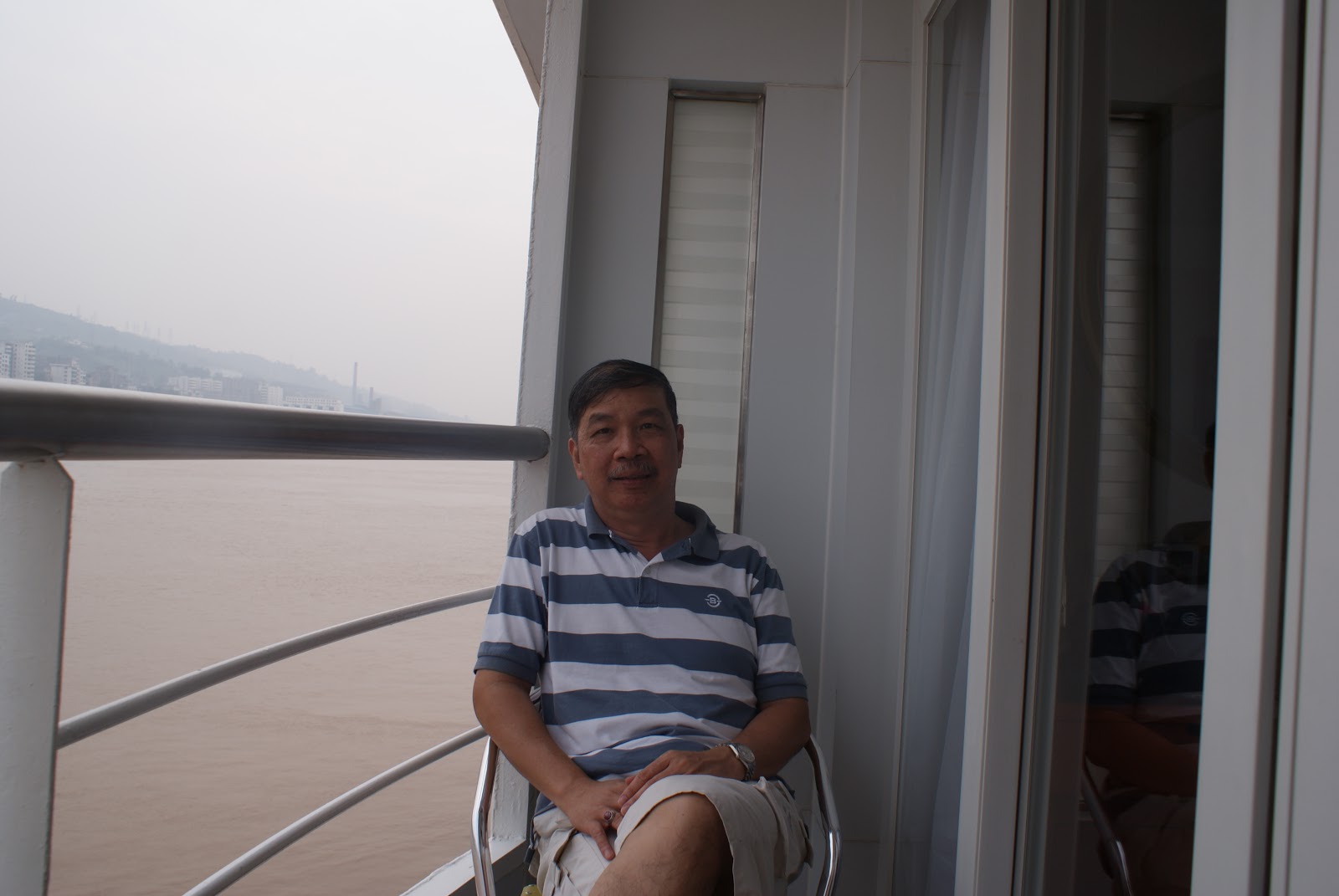
As the ship sailed slowly along the Yangtze River, We sat on chairs at balcony outside our room and admired the spectacular scenery, the hills, the country life along the Yangtze River. The Three Gorges region is a scenic area along the Yangtze River which is classified a 5As scenic area by the travel authority of China. The Three Gorges span from the western cities of Fengjie and Yichang  eastward to Hubei province. This region attracts global attention due to the Three Gorges Dam, which is firmly changing the culture and environment of the river and Three Gorges region. Three Gorges region has a total length of approximately 200 kilometres (120 mi). The Three Gorges occupy approximately 120 kilometres (75 mi) within this region. Although it is primarily famous for its scenery, the Three Gorges region is also a historically and culturally important location in China. Many settlements and archaeological sites will be under submersion from the rising Three Gorges Dam. Apart from preventing floods that occur frequently downstream of the Yangtze River, the Three Gorges Dam main function is to generate electricity. It can be considered the world's largest power station in terms of installed capacity (22,500 MW) with state-of-the-art turbines installed.
For more information on the history of the dam, click: http://en.wikipedia.org/wiki/Three_Gorges_Dam
Yangtze River
Gorges of Yangtze


When the ship reached the Three Gorges Dam, all the tourists left the ship and boarded buses to visit the Dam and tour the vicinity. The Three Gorges Dam was constructed in the middle of the Xiling Gorge. The reservoir dam was completed in the summer of 2006 and the whole project was completed by the end of 2008. When we visited this place 2 years ago, a ship lift has been constructed where our cruise ship entered the lift to reach a higher water level upstream before the ship could leave the lift and continue its journey. How it works is explained here. The lift looks like a container with deep walls and gates at both ends.The ship lift spans across the river. When the gate at downstream opens, ships can then sail into the compartment of the lift. It can accommodate a few ships. When all the ships entered into the compartment of the lift, the gates are closed. Water is pumped into the compartment, this will take several hours for water to fill up the compartment. As a result, the ships are now floating at a higher level. When the water level reaches the same level of the river upstream, the gate at the other side is opened, then all the ships can sail out and continue their journey upstream of the River Yangtze. We witnessed the closing and opening of those huge gates of the lift. It was incredible, what a sight! The dam and Three Gorges Reservoir has had a massive impact upon the region's ecology and people, involving the mass relocation of towns and villages. The higher water level has changed the scenery of the Three Gorges, so that the river is wider and the mountains appear lower. However, the mountains still tower above the river, and the gorges continue to offer spectacular views of the surrounding cliffs. The riverboat companies that operate in the Three Gorges are experiencing a boom in demand for river cruises. The increased width and depth of the river permits larger ships through the gorges, and there has been a significant increase of river traffic of all kinds, including bulk cargo and container barges.
The Tree Gorges Dam
Our 4-day stay at the cruise ship was not boring at all as there were a lot of activities organised for us on board the ship. First, when we arrived at the river port of Yichang, we were greeted by lion dance and staff of the ship. The second night, the Captain of the ship and his crew threw a welcoming party for us with wine and cocktails. This was followed by performance from the staff of the ship. All the workers of the ship, from cleaners, waiters to chef were all well trained in dancing, singing and even magic shows and games with prizes to win. The tourists were well entertained by the staff of the ship. On other day, there were cooking lessons for the wives and Taiji lessons for the men (if you can wake up early). The food was equally marvellous, buffet (continental style) in the morning and afternoon and dinner (ten per table, Chinese food) at night. When the ship reached a tourist spot, the tourists would disembark and went to the attraction in buses. There were also cultural performances to celebrate the National Day (October the 1st) and an artist did a painting session to promote his arts. On the last day, there was a farewell party organised again by the Captain and his crew. Wines and cocktails were served and performances organised to entertained the guests. We really felt that we were pampered like little children. No wonder the cruise along the Yangtze River were hot items these days. Make sure you book early to avoid disappointment. The tour fare is very much cheaper than the one you would pay for a cruise in the Alaska region. We enjoyed this tour so much that we are thinking of going back again sometime in the future, a great way to relax and admire the beauty of nature at an affordable price.

Ship entering the lift
Cruise ship inside the lift


Toasting with the Captain and crew
Ten Yuan Bill showing the Gorges
Relaxing outside my room


A view from the ship
Gate closing before water pumped in
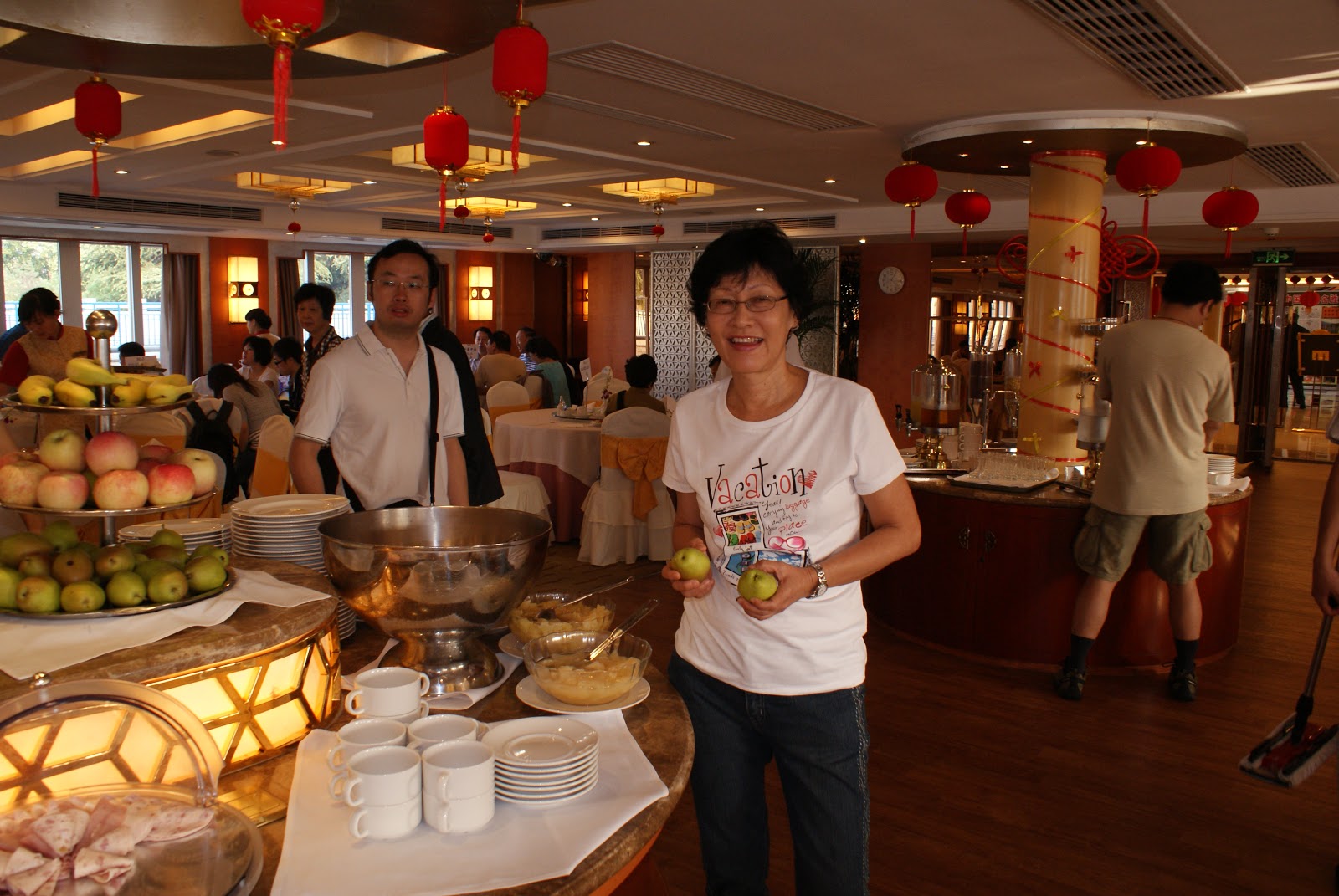
Morning buffet onboard ship
Other stops the ship made besides the Three Gorges Dam included a visit to the temple (White Emperor City) where Liubei assigned his prime minister Kong Ming a task to gloom his son to take over the reign of the Shu Dynasty (a famous story in the Romance of the Three Kingdoms); a ghost town and little three gorges (where tourists boarded a smaller ship to venture further into the region).
Relaxing at top deck
Venture into little three gorges

Thursday, 11 April 2013

Wine Making Made Easy


Wine making can be fun and interesting. I remembered my student days in UK in the 80s where I started drinking wine and then later making my own wine. It wasn't that difficult to make wine as there were wine kits available in most supermarkets there. Following instructions given by the manufacturer of the wine kits, I was able to start making wine with a very small capital investment (in terms of basic equipment). After a few trials, I was able to make wine of acceptable quality for my own personal consumption. The cost of ingredients at that time was under 2 sterling pounds, it was sufficient to make 6 bottles of wine. Ordinary table wine at local supermarkets (Tesco, Marks & Spencer) was selling at 2 sterling pounds a bottle. There was significant savings if one knows how to make quality wine for his own consumption. I had also experimented making wine from apples or even flowers. That was almost 30 years ago, but I could still remember the joy and excitement when I opened the first bottle of my own labour. It may not taste fantastic but  the alcohol content in it confirmed that it was wine. Later I realised that the quality of the wine could improve further if I allowed it to age in bottles over a year or two. Although I may not be able to make wine here, I believe the technique is the same. If you can get the equipment, surely making wine is as easy as ABC. But check with the authority first to find out if it is legal to make your own wine, may be you need to pay tax before wine making is allowed here. Here is my past experience which I would like to share.
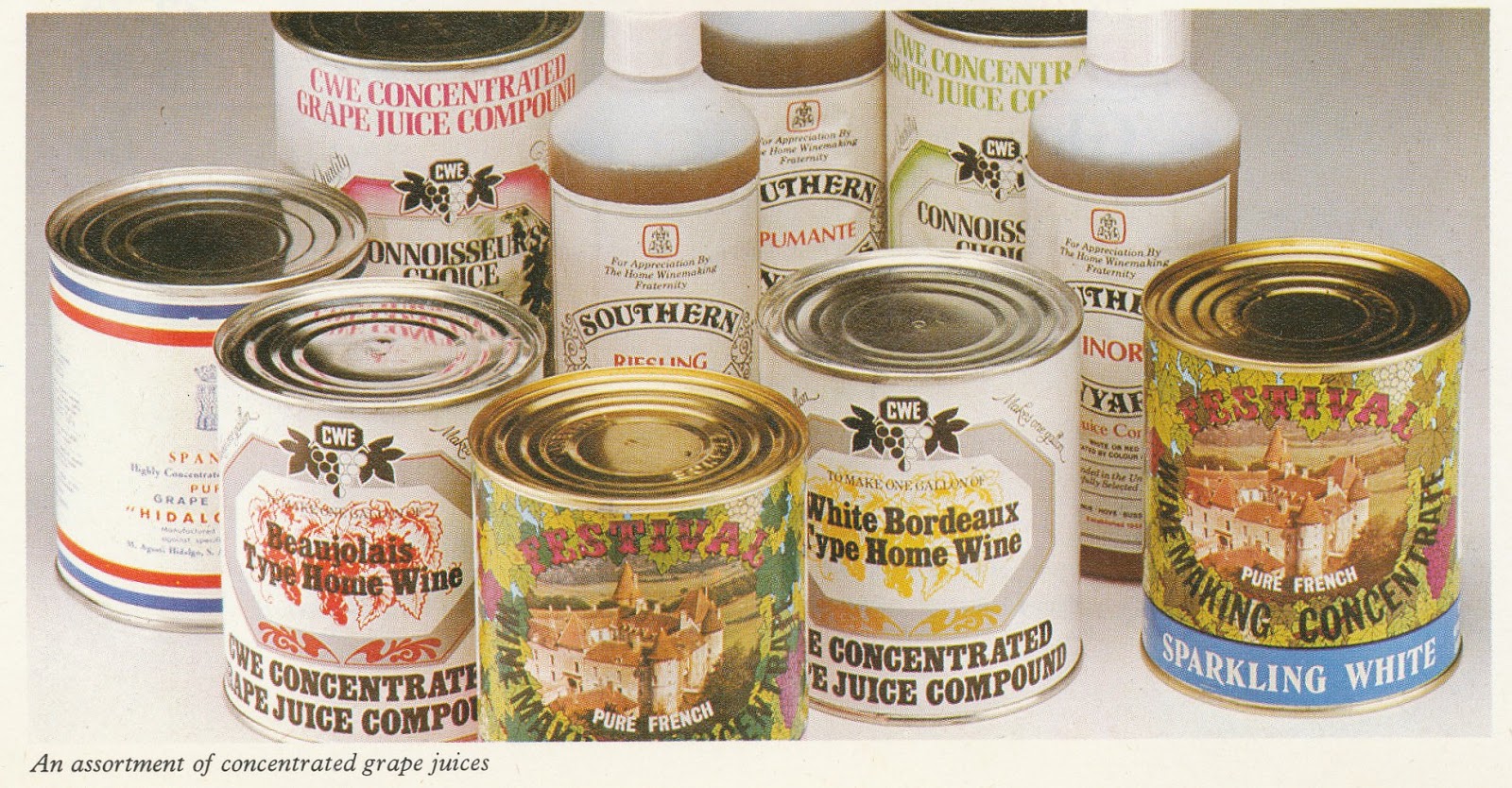
Cans of concentrated grape juice
In wine making, the equipment is simple. You need a glass jar (demijohn), a bored cork bung to fit the jar and an airlock to fit into the hole in the bung, a plastic funnel and plastic tubing, six wine bottles and corks. Besides the basic wine making equipment, you need ingredients such as a can of concentrated grape juice, water, some sugar and yeast. Just follow the recommendations of the manufacturer on the amount needed to produce 6 bottles of  home made wine.
Basic equipment
Prior to making wine, all the equipment must be carefully sterilised as we don't want to take chances, contaminated equipment can produce unclean wine that can land you in hospital. Equipment sterilising can be achieved using sterilising tablets purchased from a drug store. Having cleaned the equipment, pour a can of concentrated grape juice into the glass jar, add water and sugar (this will boost up the alcohol level during fermentation). Some people prefer to make wine from fresh fruits such as apples or berries. Then separate procedure is required to extract the sugar content in the fruits to turn it into wine. Anyway, this wine making session is about making wine from concentrated grape juice. With the glass jar filled up to 3 quarters of grape juice, the next step is to prepare the yeast culture in a bottle. Dry yeast compound is put inside a bottle containing sugar water and leave it standing in a warm place for 30 minutes with cotton wool plugged at the opening. When you see bubbles rising from the yeast culture in the bottle, fermentation has began. The content is then poured into the glass jar to induce fermentation. Then fit in the airlock to the glass jar, fermentation of the grape juice will begin soon. If everything goes on smoothly, bubbles (carbon dioxide) can be seen rising and escaping from the grape juice through the airlock. It is important to make sure that the jar is not filled up to the rim of the jar for safety reasons. The function of the airlock is to alloy only the carbon dioxide from fermentation process to escape into the atmosphere and prevents bacterial and micro-organisms from entering the jar to contaminate the wine.
Adding more sugar


Yeast in bottle
If the temperature is low in the house, i.e. winter time in cold countries like the UK, the glass jar with its fermenting content must be suitably heated up, or else fermentation may stop. Meanwhile topping up the jar with more water and sugar is necessary. It may take up to a week until fermentation process stops, i.e. the sugar content in the jar has been converted to wine. This can be observed easily when no more bubbles are seen escaping from the airlock. By then a layer of deposits or yeast sediments will be formed at the bottom of the jar. The wine needs to be filtered out into a new jar for storage. At this stage the wine will taste a bit flat if you drink it straight away. It is best kept for a few months at cool temperature before bottling into wine bottles.


Properly labelled wine in storage
Filtering wine
The specific gravity of the wine is checked to ensure that there is no residue sugar in the wine before bottling. Otherwise, the wine can start fermenting again if the temperature is high enough and there is some residue yeast in the wine. This is how champagne is made, it needs more elaborate equipment to remove the yeast sediments in bottles.

 
Checking density of wine before bottling


Home made wine labels
Once the wine is bottled, it is recommended that the wine be stored in bottles for ageing to take place. The longer you keep the wine in storage, the better it becomes. Generally the wine is kept in bottle for one to two years in bottles before consumption.
Fermentation taking place
 
Having fun with wine that you made


Wednesday, 10 April 2013

The Forbidden City

When you are in Beijing, the capital city of China, you surely don't want to miss this world heritage site, the Forbidden City  or the Imperial Palace of the Ming and Qing dynasties. Tourists all over the over who visited the palace, marvel at its sheer size and the magnificent buildings that symbolise old traditional Chinese style of architecture. The palace is magnificent as the construction materials used include whole logs of precious Phoebe zhennan wood ( 楠木) found in the jungles of south-western China, and large blocks of marble from quarries near Beijing. The floors of major halls were paved with "golden bricks" ( 金砖), specially baked paving bricks from Suzhou.

Now, a brief history is presented here on the construction of this palace. When the Mongols ruled China during the Yuan dynasty from 1271 to 1368, they established the capital here but it was called Dadu 大都 at that time. The Yuan dynasty lasted less than a hundred years before it was overthrown by the Han Chinese under the leadership of Zhu Yuanzhang (朱元璋) and the Ming dynasty was established, the capital was then shifted to south to Nanjing and the palace built by the Mongols was burnt down by the first Ming emperor (Hongwu Emperor). However, it was during the reign of the third Emperor of Ming, Zhu Di ( Hongwu 's fourth son, also known as Yongle Emperor) who shifted the capital back to Beijing after realising the strategic importance of the city. This was after Zhu Di seized the throne from his nephew (the son of Hongwu 's crown prince who died before taking over the throne) after a 4 year civil war. At that time, the threat from foreign invasion was from the North, hence it was important to station troops and state administration in Beijing to safeguard the interest of the empire. So Zhudi planned to shift the capital to the north, to Beijing. Although most court officials were against the idea of shifting the capital (a waste of useful resources), he refused to listen to their advice and ordered the construction of this huge palace in 1406. It took 14 years before construction was finally completed in 1420 and this palace is what we know today as the Forbidden city.
Inside the Palace
The Front View
For almost 500 years, the Forbidden City was the home of emperors of the Ming and Qing dynasties and their households. The whole compound consists of over 9000 rooms and covers an area of 720,000 m2 (7,800,000 sq ft).  You may ask why such a big palace was built for the emperors to stay. But if you think hard enough you will know why. The emperors those days had hundreds of concubines and their sons and daughters were numerous. For example, the Emperor Kangxi of the Qing Dynasty had over thirty children. Hence, it was not difficult to understand why such a big palace was indeed needed to house the emperors' households. When we were there, we could not even cover the whole compound of the palace. It was really tiring going from chamber to chamber. During peak season, I was told that the tourists could not even have space to walk. But having said that, the Emperors those days did not have to walk as they were carried around in sedan chairs. They were really fortunate and enjoyed supreme power.

Do you know, a total of 24 emperors from the Ming and Qing dynasties lived in the Forbidden City. With the abdication of Puyi, the last Emperor of China after the revolution in 1911, he was allowed to stay in the inner court of the palace where the outer court was assigned for public use. Puyi was finally evicted from the palace in 1924 and the Palace Museum was formed in 1925 to take over the administration of the Forbidden City. The Palace Museum houses the national treasures from the Ming and Qing era and for the first time ordinary citizens were allowed entry to the Forbidden City to view the valuable exhibits. With the invasion by the Japanese army in 1933, the national treasures were force to evacuate the museum.

The Forbidden City was declared a World Heritage Site in 1987, and is listed by UNESCO as the largest collection of preserved ancient wooden structures in the world. Since 1925, the Forbidden City has been under the charge of the Palace Museum, whose extensive collection of artwork and artifacts were built upon the imperial collections of the Ming and Qing dynasties. Part of the museum's former collection is now located in the National Palace Museum in Taipei. Both museums descend from the same institution, but were split after the Chinese Civil War. After the war, the Forbidden City was under major repair to restore the palace to its original condition.

View taken from a park on a hill facing the palace

A Jade Mirror
Jade Cabbage, in Taipei Museum
         
          假期相约来北京

          中国古都好风景

          未登长城非好汉

          不游故宫枉此行

For more infomation on the Ming Dynasty: http://en.wikipedia.org/wiki/Ming_Dynasty
The Imperial Palace or Forbidden City: http://en.wikipedia.org/wiki/Forbidden_City
The Yuan Dynasty: http://en.wikipedia.org/wiki/Yuan_Dynasty

Tuesday, 9 April 2013

Xian and The Terracotta Army

If you have been to Xian 西安 , you will notice that Xian is a very old city rich in history and heritage, as it was the capital of many ancient dynasties such as the Zhou, Qin, Han, Sui and Tang. The city was previously known as Chang Ann. It is the eastern end of the silk Road trail and home to the Terracotta Army. I have visited Xian on two occasions, one on the Shanxi Tour and the other on the Silk Road Tour on an express train charted by tour agent.

On my first visit to Xian, we went to the tomb of the Yellow Emperor or Huangdi who was portrayed as the originator of the Chinese civilisation and also the ancestor of all Huaxia Chinese. Hence, it is the wish of Chinese people all over the world to come here to pay tribute to this legendary ancestor.
Tomb of Yellow Emperor

Inscription praising Huangdi


Water Fall at Yellor River

Terracotta Army


The highlight of the tour to Xian was a visit to the tomb of Qin Shi Hwang or the First Emperor of China. This is also the home of the terracotta army uncovered accidentally  in 1974 in Shaanxi province by a group of farmers when they were digging a water well at Mount Li (Lishan), near the tomb site of Qin Shi Huang. Fragments of terracotta warriors were dug up by the farmers in the area which  prompted Chinese archaeologists to investigate and unearth the largest pottery figurine group ever found in China.The Terracotta Army or the "Terracotta Warriors and Horses" of the Qin Dynasty. The terracotta army is a collection of clay sculptures depicting the armies of Qin Shi Huang, the first Emperor of China. The terracotta army was buried with the emperor in 210–209 BC to protect the emperor in his afterlife. The clay warriors are life-sized and vary in height according to their roles, with the tallest being the generals. Besides warriors, chariots and horses were also uncovered.

Our tour guide told us that only 10% of the this vast burial site was open to tourists and we were only allowed to view the exhibits at 3 pits. The rest of the site remains untouched as the authority wanted to preserve the artifacts in its original condition. The unearthed warriors, when first discovered, were very colourful.They were painted with bright pigments in pink, red, green, blue, black, brown, white and lilac. Once they were unearthed, the colour coating began to fade and even flake off. Hence it was better to leave the remaining terracotta army remained where they were. At first three farmers were the first to dig out the fragments, two fled the site for fear of evil spirits (they thought they saw ghosts), only one farmer by the name of Yang realised that these were treasures of the past era. He then brought the terracotta pieces to the authority and was handsomely rewarded with money, land and a new house. His discovery was very significant, it could be said at that time the great discovery of the century, for the tomb of the First Emperor who lived more than 2000 years ago was finally discovered. It would become a national treasure and a world heritage. The whole village was relocated somewhere else with each villager given land and also a new house. Hence it was said that all the villagers struck gold with the finds of this farmer Yang who now sits daily at the souvenir shop inside the museum busily signing his name on the books (on terracotta army, what else) purchased by tourists (earning extra income). He has become an instant celebrity and a multi-millionaire.

 In addition to the clay warriors, an entire man-made underground palace for the Emperor has also been found around the first Emperor's tomb mound which is located at the foot of Mount Li as an earthen pyramid. It consists of several offices, halls, stables and other structures placed around the tomb mound which is surrounded by two solidly built rammed earth walls with gateway entrances.

Terracotta horses
Some exhibits in the pit
Besides the terracotta army museum, we also visited some historical sites of the Tang Dynasty as this place was previously known as Chang Ann, the ancient capital of the Tang Era. A notable site is the bath tub reportedly used by the famous concubine of the Tang Emperor (Tang Xuanzong), Lady Yang (Yang Guifei), to bathe. The Emperor was madly in love with her as she was one of the four most pretty women of ancient China. The Emperor liked her so much that her father was made the prime minister and all her relatives were given high posts in the Imperial court. It was said in those days that "it was better to give birth to daughters than sons to enjoy such imperial honour". The Emperor began to indulge himself in songs, wine and beauty and neglect state affairs. The general of a foreign tribe then seized this opportunity and staged a rebellion trying to overthrow the Tang Dynasty. His army succeeded and conquered the Palace. The Emperor fled the Palace with his favourite concubine, the Lady Yang. When the defeated Tang army regrouped, the soldiers refused to quash the rebellion unless the Emperor killed the concubine. Reluctantly the Emperor handed a rope to the concubine asking her to commit suicide. The Tang army, led by the Emperor's son, eventually won the battle and the Dynasty was restored. The young prince took over the throne leaving his father (the Emperor) lived out his remaining days in the palace thinking and dreaming of his beloved concubine. The love story between the Tang Emperor and lady Yang became many subjects in plays, essays and poems written by scholars of all ages.

We were able to watch a stage drama of the love affair between the Tang Emperor and Lady Yang during the tour. This drama was unique in a way as the audience not only could see the acting (a lot of dancing and singing), they could also smell the fragrance of flowers when Lady Yang was bathing and the burning smell of fire and smoke when the soldiers were fighting and the palace in ruin. This is an experience not to miss if you were to visit Xian, other than the terracotta museum, the Tang Palace and the great waterfall at the mouth of the Yellow River.

For mre information on Yang Guifei, click this link and her love story with the Emperor Tang Xuanzong: http://en.wikipedia.org/wiki/Yang_Kuei-fei

Yang Guifei's Bath Tub

Huashan


Waterfall of Yellow River


A Stage Drama on Yang Guifei


    炎黄子孙来中原

    寻根祭祖黄帝园

    黄帝伟业传千里

    中华文化五千年

Sunday, 7 April 2013

The story of Ah Q

     
Another place I visited while in Zhejiang was the home town of Lu Xun 魯迅 . If someone mentions Luxun, undoubtedly the story of Ah Q straight away comes to his mind. Lu Xun was a famous writer of short stories who was active in the 1920s, the turmoil times in China after the collapse of the Qing Dynasty. I remembered during my early school days, some essays in this book called The True Story of Ah Q 阿Q正传 were in our school's textbook. The author of this book was none other than the great writer Lu Xun who was considered by many to be the leading figure of modern Chinese literature. From young, most of the pupils of my time were exposed to his writings to the extent that we were asked to memorise the texts and answer questions related to the story in our school examinations.

The True Story of Ah Q 阿Q正传 is generally held to be a masterpiece of modern Chinese literature, since it is considered the first piece of work fully to use Vernacular Chinese after the 1919 May 4th Movement in China. It was first published in the Beijing Morning News supplement as a serial. The true story of Ah Q traces the "adventures" of Ah Q, a man from the rural peasant class with little education and no definite occupation. Ah Q is famous for "spiritual victories", Lu Xun's euphemism for self-talk and self-deception even when faced with extreme defeat or humiliation. Ah Q is a bully to the less fortunate but fearful of those who are above him in rank, strength, or power. He persuades himself mentally that he is spiritually "superior" to his oppressors even as he succumbs to their tyranny and suppression. Lu Xun exposes Ah Q's extreme faults as symptomatic of the Chinese national character of his time. The ending of the piece – when Ah Q is carted off to execution for a minor crime – is equally poignant and satirical. In the last act, Ah Q is arrested as a scapegoat for looting and sentenced to death by the governor. When Ah Q is asked to sign a confession, he worries that he cannot write his name. The officers tell him to sign a circle instead. Ah Q is so worried about drawing a perfect circle to save face that he is unaware he would be executed until it is too late. Before his death he tries to entertain the crowds watching his execution, but cannot decide on suitable lines from any Chinese opera (synopsis taken from wikipidia).

In the beginning, Lu Xun's ambition was to become a medical doctor to save as many lives as he possibly could. During those time, standard of living was poor, medical care was expensive and inadequate and beyond the reach of the poor and desolate. As a result many people died for not being able to seek treatment when they fell ill. But later he realised that even if  he became a doctor, he could only save a handful of them; these lives were insignificant compared to the large multitude that needed help. He had bigger idea, to do something to change people's mindset, character and attitude which he considered old-fashioned. The people of China had been living under the old feudal systems for too long, the society was corrupt and so were the people . Since this was the era of a new China, people's mindset and behaviour needed to change and China could then be a great nation. After careful consideration, he chose to become a writer and he wanted to excel and achieve fame in the literature circle. He knew if he became famous many people would read his works. As a result, he would be able to influence them using plots and characters he used in his writings. Some of the plots or characters he frequently chosen were satirical in nature. They were designed to attack the old society and its unhealthy culture which poisoned and corrupted people's mind. As a writer, he could reach out to the great multitude, this would be many times better than a medical doctor, who could only save people's lives but not their souls and minds. Hence, the story of Ah Q was just an example he used for this purpose. There were also many other essays and short stories he had written, most of his writings were also translated in other languages and appeared widely in the literature circle internationally. If you look at the success of the nation now, you would have agreed that he had achieved his goals. The renowned artist Wu Guangchong once commented that a hundred Qi Bashi could not compare to one Lu Xun, you can imagine the status of Lu Xun in the people's heart.

I have some photos taken when I was at the residence of Lu Xun during my Zhejiang tour for sharing:
Lu Xun's hometown
Lu Xun's Study
Lu Xun's bedroom


Lu Xun, figurine made in the 60s
TheStoryofAQreprint.jpg
The Book
In modern Chinese language, the term the "spirit of Ah Q" or "Ah Q mentality" (阿Q精神) is used commonly as a term of mockery to describe someone who chooses not to face up to reality and deceives himself into believing he is successful, or has unjustified beliefs of superiority over others. It describes a narcissistic individual who rationalises every single actual failure he faces as a psychological triumph ("spiritual victory").
      
If you are interested to know more about the writer and his work, please click below:
                       http://en.wikipedia.org/wiki/Lu_Xun
and                 http://en.wikipedia.org/wiki/The_True_Story_of_Ah_Q
   
 A poem for sharing:
                      品甞黄酒绍兴

           鲁迅故里留足印

           兰亭溪旁古迹

           乌蓬船上心